Best for
- Metal marking shops
- Buyers evaluating black or color-marking development
- Teams comparing 20 W, 30 W and 60 W configurations
Watch for
- Alloy and finish control outcomes
- Power tiers do not create comparable bundles
- Open MOPA stations still need engineered controls
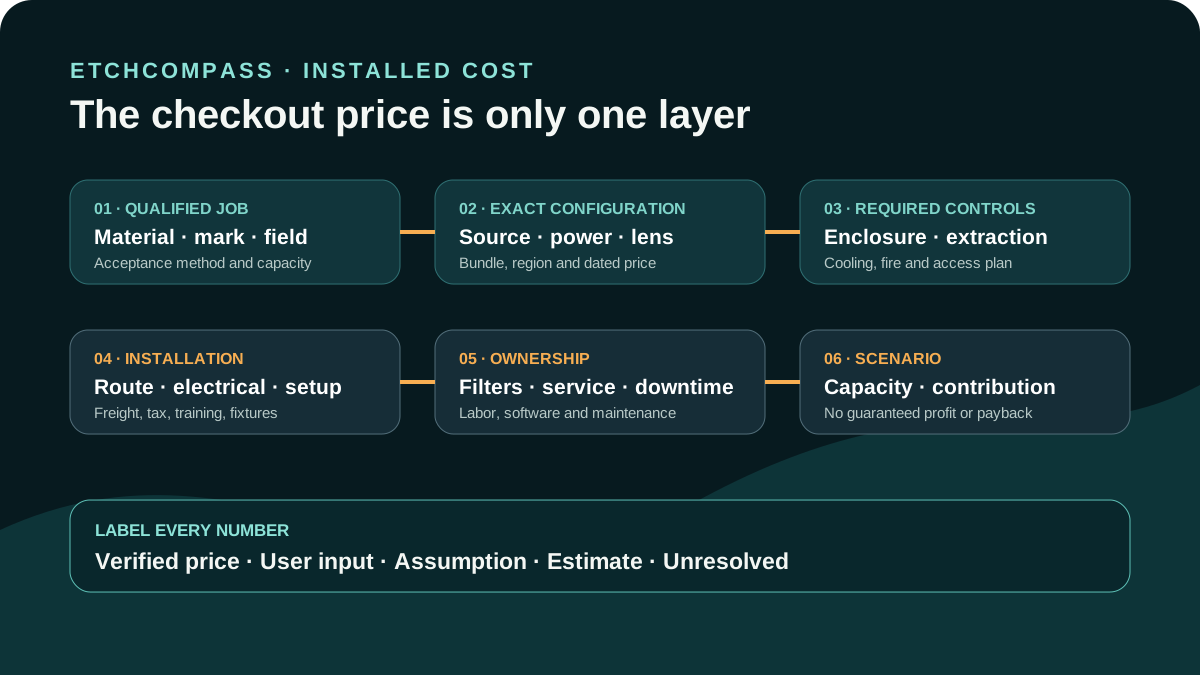
Anchor the budget to an exact tier
The official ComMarker B6 MOPA listing showed USD $2,599, $3,099 and $3,999 Basic configurations for 20 W, 30 W and 60 W variants when verified 7 Sep 2026. Its listed Ultimate configurations added an enclosure, extractor and rotary and extended higher.
These are dated vendor prices, not expected street prices for every MOPA system. Record the exact JPT source, power, field lens, bundle contents, region and cart date.
Prove the premium with samples
Specify alloy grade, surface finish, mark appearance, depth or contrast, abrasion requirement and inspection method. Require supplier-supported samples or a controlled paid sample run on the exact source and lens before treating a marketing image as reproducible evidence.
Color and black marking are process-development tasks. Their repeatability depends on the alloy, finish, preparation, parameters, focus and environment; the MOPA label alone proves none of them.
Price the whole station
Add the enclosure or controlled area, extraction based on the target contaminants, fixture plate, lens set, rotary, computer, compatible software, electrical provision, training, commissioning and sample qualification.
If the system is used open, a shield sold in a bundle is not automatically a complete protective housing. Base the control plan on the exact system classification and professional assessment.
Compare against conventional fiber
Model the lowest conventional-fiber configuration that can meet the same acceptance criteria. Then compare installed cost, development time, rejected parts, changeover, maintenance, support and credible finished-parts capacity.
If conventional fiber passes the mark specification, the unused pulse flexibility has no automatic economic value. If it fails a documented requirement that MOPA passes, the premium has a defensible job.
Who should wait
Wait when the alloy is unknown, the desired effect has not been defined, no exact-source sample exists, the open-beam station cannot be controlled, or the business case depends on guaranteed color or volume.
Do not turn a vendor speed maximum into units per hour. Time data preparation, fixturing, focus, marking, inspection, cleaning and rework.
MOPA expands control; it does not guarantee a particular color or mark on every alloy. Qualify the exact material, source, lens and acceptance method.
Decision criteria
Primary and authoritative sources
A source link supports the stated fact; it is not an endorsement.