Best for
- Electrical-part marking
- Copper jewelry and gifts
- Buyers comparing UV and fiber evidence
Watch for
- Bare copper is highly reflective
- Alloy and plating change absorption
- Conductivity-sensitive parts need defined heat limits
Machines in this decision
Merchant links are standard outbound links. No active affiliate relationship is recorded, and relationships never affect rankings or tool results. Affiliate status is not a ranking input.
ComMarker Omni X UV
Evidence recordUV · 6 W or 12 W configurations · 70 × 70 mm and 150 × 150 mm fields listed in the 6 W Basic bundle; configuration dependent
- Fit
- specialist UV cost research
- Watch
- not a universal cutter
- Price context
- $3,599 — US 6 W Basic promotional price observed 7 Sep 2026; power, lens, slider, rotary and extractor change cost
WeCreat Lumos Ultra
Evidence recordDual UV/MOPA · 6 W UV; optional 60 W or 100 W MOPA · 210 × 210 mm standard
- Fit
- specialized UV marking
- Watch
- preorder timing conflicted
- Price context
- $3,799 — US UV Basic preorder price observed 3 Sep 2026; configurations extend much higher
Monport GM 60W Pro MOPA
Evidence recordMOPA fiber · 60 W · 175 × 175 mm
- Fit
- small-format metal marking
- Watch
- open workflow needs a controlled-area assessment
- Price context
- $4,006.37 — US autofocus Pro price observed 3 Sep 2026; the lower $3,900 option is manual-focus, not the same configuration
Evidence desk
Side-by-side documented facts
Each record shows its evidence date. Prices, bundles, availability and regional terms can change; recheck the exact configuration before purchase.
| Criterion | ComMarker Omni X UV | WeCreat Lumos Ultra | Monport GM 60W Pro MOPA |
|---|---|---|---|
| Laser process | UV · 6 W or 12 W configurations | Dual UV/MOPA · 6 W UV; optional 60 W or 100 W MOPA | MOPA fiber · 60 W |
| Published work area | 70 × 70 mm and 150 × 150 mm fields listed in the 6 W Basic bundle; configuration dependent | 210 × 210 mm standard | 175 × 175 mm |
| Enclosure / class context | Protective configuration varies by bundle; exact system classification was not established in reviewed text | System class not established in reviewed source | Open marking format; official manual warns there is no protective housing |
| Ventilation context | 100 W extractor appears in selected bundles; suitability depends on the exact material and route | Extractor optional for most listed configurations | Material-dependent dedicated extraction may be required; no extractor is assumed included |
| Machine dimensions | Not established in the reviewed evidence | 450 × 270 × 442.8 mm | 400 × 330 × 620 mm |
| Published weight | Not established in the reviewed evidence | 20 kg | 16.6 kg net |
| Rotary compatibility | R5 rotary appears in selected current bundles | Rotary supported up to a stated 100 mm diameter; rotary plus slider up to 380 mm length | Rotary supported; an optional rotary-axis variant was listed at $4,176.37 on 3 Sep 2026 |
| Electrical / cooling | Not established in the reviewed evidence | Not established in the reviewed evidence | 110–120 V, 60 Hz US configuration · Air cooled |
| Software | Verify the exact current software and operating-system support | MakeIt and LightBurn on Windows/macOS; USB and Wi-Fi | BslAppSimple and LightBurn on Windows/macOS; USB connection |
| Availability | 6 W and 12 W configurations listed on the official US page on 8 Sep 2026 | Preorder; current product page estimated mid-October shipping when checked 3 Sep 2026 | Autofocus Pro configuration listed with an early-October ship estimate on 3 Sep 2026 |
| Published price | $3,599. US 6 W Basic promotional price observed 7 Sep 2026; power, lens, slider, rotary and extractor change cost | $3,799. US UV Basic preorder price observed 3 Sep 2026; configurations extend much higher | $4,006.37. US autofocus Pro price observed 3 Sep 2026; the lower $3,900 option is manual-focus, not the same configuration |
| Warranty context | Verify current regional warranty and selected configuration before purchase | 12 months | Product page lists two years for the machine and one year for the laser source |
| Evidence verified | Sep 8, 2026 | Sep 8, 2026 | Sep 3, 2026 |
Separate copper from brass and coatings
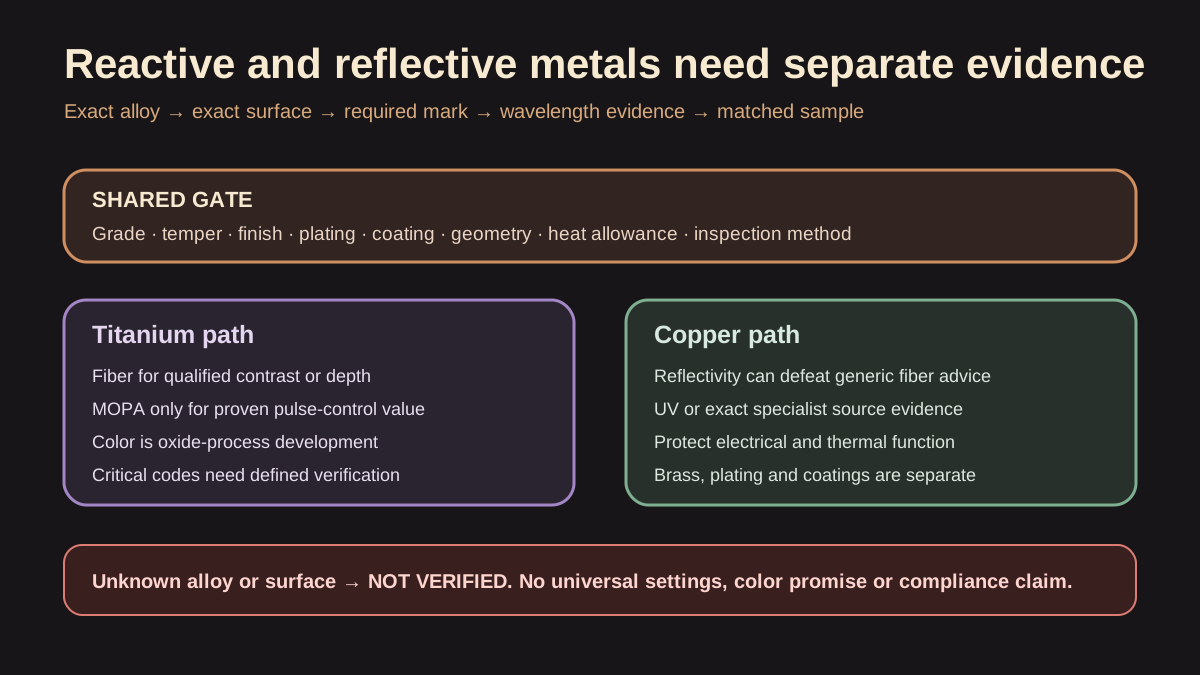
Record the exact copper alloy, temper, surface finish, plating, oxide, lacquer and adhesive layers. Brass is a copper alloy with its own composition and contaminant questions; a painted or plated copper item is a layered-material workflow.
If the surface identity is unresolved, do not process it.
Why a UV path enters
KEYENCE documents strong UV absorption and high-contrast copper marking while warning that copper reflectivity can make conventional fiber marking ineffective. Its example establishes a technology decision, not universal performance for every machine.
Compare an exact UV source, lens, field, object height and documented copper sample. Keep heat, conductivity and residue acceptance explicit.
When another metal source can participate
Hybrid or manufacturer-documented fiber/MOPA systems may participate when the vendor supports the exact alloy and the matched sample passes. A broad metals list is not enough for reflective copper.
Do not infer that higher average power fixes absorption or heat-control problems. Require an exact source, lens and material record.
Define the finished-part acceptance
Specify contrast, depth, allowed oxidation, edge quality, electrical conductivity impact, readability and abrasion requirement. Use the production surface condition and geometry in the sample.
Record fixture, focus, cleaning, extraction and inspection. For codes, use the required verification standard rather than visual judgment alone.
Who should choose neither
Choose neither when the alloy or plating is unknown, the electrical or thermal function cannot tolerate an unvalidated process, or reflective-target and emissions controls are unresolved.
Outsource early critical parts to a supplier that can provide exact-process samples and verification records.
Copper sources were rechecked 9 Sep 2026. No generic setting, source-power rule or guaranteed mark is published.
Decision criteria
Primary and authoritative sources
A source link supports the stated fact; it is not an endorsement.
- KEYENCE: laser engraving copper
- KEYENCE: fiber, CO2 and UV material comparison
- OSHA: laser hazards and controls
- ComMarker Omni X UV: Official ComMarker Omni X UV product page
- WeCreat Lumos Ultra: Official Lumos Ultra product page
- Monport GM 60W Pro MOPA: Official GM60 Pro MOPA product page
- Monport GM 60W Pro MOPA: Official GM Pro quick-start manual