Best for
- Established acrylic and wood shops
- P2S buyers considering a P3 step-up
- Teams planning batch and sign capacity
Watch for
- P3 is 105 kg
- P2S class varies by SKU
- P3 conveyor use changes its classification to Class 4
Machines in this decision
Merchant links are standard outbound links. No active affiliate relationship is recorded, and relationships never affect rankings or tool results. Affiliate status is not a ranking input.
xTool P3
Evidence recordCO2 · 80 W · 915 × 458 mm
- Fit
- larger-format enclosed CO₂ workflow
- Watch
- 105 kg machine demands route and bench planning
- Price context
- $6,999 — US standalone price observed 3 Sep 2026; Versatile was $8,209 and All-in-one $10,459
xTool P2S
Evidence recordCO2 · 55 W · 600 × 305 mm
- Fit
- premium enclosed CO₂ workflow
- Watch
- regional SKU/class and warranty must match
- Price context
- $2,999 — US standalone price observed 3 Sep 2026; Versatile was $4,169 and All-in-One $5,069
Evidence desk
Side-by-side documented facts
Each record shows its evidence date. Prices, bundles, availability and regional terms can change; recheck the exact configuration before purchase.
| Criterion | xTool P3 | xTool P2S |
|---|---|---|
| Laser process | CO2 · 80 W | CO2 · 55 W |
| Published work area | 915 × 458 mm | 600 × 305 mm |
| Enclosure / class context | Class 1 in the documented standalone configuration; adding the intelligent conveyor changes the system to Class 4 | Sold in documented Class 1 and Class 4 versions; verify the exact SKU before purchase |
| Ventilation context | IF2 2.0 inline fan included; AP2/AP2 Max filtration is separate unless included in the selected bundle | Built-in 145 CFM exhaust fan and exhaust hose; official guidance routes outdoors and filtration is optional |
| Machine dimensions | 1,250 × 780 × 496 mm in the product/manual table; the FAQ gives 808 mm depth, so plan the route conservatively | 1,000 × 639 × 268 mm |
| Published weight | 105 kg | 45 kg (99.21 lb) |
| Rotary compatibility | Optional RA3/RA2; published ranges depend on roller, chuck, sphere and ring configuration | Optional rotary; official FAQ lists geometry limits that change when the riser base is used |
| Electrical / cooling | 100–240 V AC, 50/60 Hz; official sources conflict between 1,400 W maximum and 1,700 W input · Built-in inverter water chiller with a 1,200 ml tank; use the exact manual's water and antifreeze instructions | Maximum machine input listed as 700 W; verify the selected regional voltage and complete accessory load · Built-in liquid-cooling system requires purified water and model-specific, temperature-dependent antifreeze preparation |
| Software | xTool Studio on Windows/macOS via USB or Wi-Fi; reviewed P3 evidence did not establish LightBurn support | xTool Studio/XCS by USB, Wi-Fi or IP; LightBurn works by cable but does not support the cameras or autofocus |
| Availability | US page listed standalone and bundled variants as available with 3–5 business-day shipping on 3 Sep 2026 | US standalone and bundles listed for sale on 3 Sep 2026; recheck the exact SKU, classification and cart |
| Published price | $6,999. US standalone price observed 3 Sep 2026; Versatile was $8,209 and All-in-one $10,459 | $2,999. US standalone price observed 3 Sep 2026; Versatile was $4,169 and All-in-One $5,069 |
| Warranty context | Current US product page states 12 months; current UK page states 24 months, so match the region and SKU | US P2-series terms: 12 months main components, six months laser tube and three months mirrors/focusing lens; regional terms differ |
| Evidence verified | Sep 7, 2026 | Sep 7, 2026 |
What xTool P3 does better
P3 documents an 80 W CO₂ source and 915 × 458 mm work area versus P2S at 55 W and 600 × 305 mm. That gives P3 roughly 2.3 times the nominal working area, which can matter for larger panels or more parts per layout.
P3 also documents multi-camera positioning, LiDAR-assisted focus, AutoLift, built-in active cooling and a 220 mm maximum object-height workflow. Those features are valuable only if they reduce a measured production constraint.
What xTool P2S does better
P2S is materially smaller and lighter at 1,000 × 639 × 268 mm and 45 kg, versus P3 at about 1,250 × 780–808 × 496 mm and 105 kg. That changes delivery route, bench, service clearance and relocation planning.
Its 600 × 305 mm area can be sufficient for many desktop acrylic, wood and personalization workflows. Choosing the smaller system preserves capital and space when P3's extra area and automation would sit unused.
Limitations of P3
P3's price, weight, depth and facility load demand a stronger installation case. Official sources conflict between 1,400 W maximum and 1,700 W input and between 780 and 808 mm depth, so conservative planning and exact-SKU confirmation are required.
The documented standalone system is Class 1, but adding the intelligent conveyor changes it to Class 4. Optional filtration, rotary, conveyor and infrared capability must be priced separately where not in the chosen bundle.
Limitations of P2S
P2S offers a smaller bed, lower source power and less automation. Its Class 1 and Class 4 versions must not be conflated, and the optional riser or conveyor-like material workflows require their own geometry and control checks.
LightBurn can operate P2S by cable but does not support its cameras or autofocus. The built-in liquid-cooling system also needs exact water and temperature-dependent antifreeze maintenance.
Who should choose each—or neither
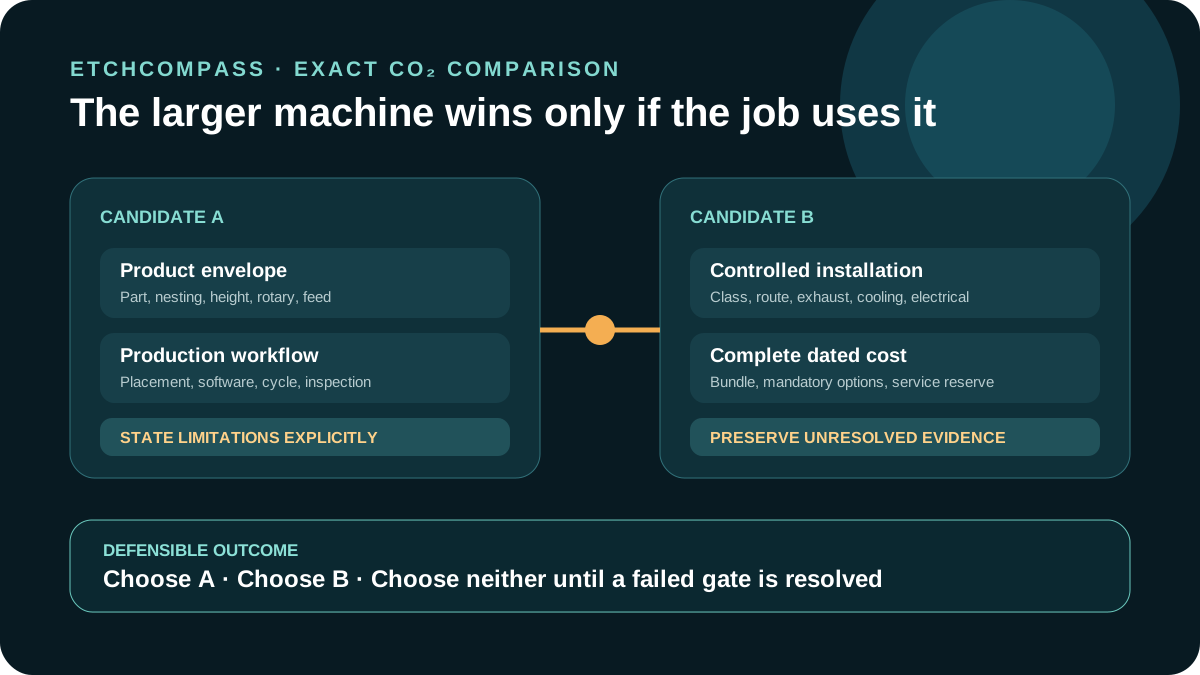
Choose P3 when measured panel size, nesting, object height or reduced setup steps justify its installation and price. Choose P2S when the smaller active area covers the catalog and desktop-scale logistics are more valuable than unused headroom.
Choose neither for primary direct bare-metal marking, unidentified materials, inadequate exhaust or fire controls, an unverified route or electrical plan, or a business case built from vendor maximum speed rather than complete cycle time.
EtchCompass has not hands-on tested either machine. This comparison uses current official specifications rechecked 7 Sep 2026 and preserves conflicts instead of inventing a winner.
Decision criteria
Primary and authoritative sources
A source link supports the stated fact; it is not an endorsement.
- xTool P3: xTool P3 official US product page
- xTool P3: xTool P3 official manual and specifications
- xTool P2S: Official xTool P2S US product page
- xTool P2S: Official xTool P2S user guide
- xTool P2S: Official P2S classification and material-safety guidance
- xTool official machine comparison
- OSHA: laser hazards and controls
- xTool P3: xTool P3 official FAQ
- xTool P2S: Official P2-series warranty periods