Best for
- Identified wood and paper products
- Dark opaque acrylic documented by the maker
- Enclosed small-format personalization
Watch for
- Clear acrylic is not a general blue-diode cutting fit
- An infrared add-on is a separate process
- Open or handheld modes change exposure controls
Machines in this decision
Merchant links are standard outbound links. No active affiliate relationship is recorded, and relationships never affect rankings or tool results. Affiliate status is not a ranking input.
WeCreat Vision Pro
Evidence recordDiode · 45 W · 500 × 320 mm
- Fit
- enclosed diode workflow
- Watch
- clear acrylic is not a documented cutting fit for the diode process
- Price context
- $1,990 — US 45W Basic package observed 11 Sep 2026; not an installed quote; price and bundle can change
WeCreat Vision 20W
Evidence recordDiode · 20 W · 420 × 290 mm
- Fit
- lower-cost enclosed diode setup
- Watch
- slower/lower-power than Vision Pro
- Price context
- $1,040 — US Basic promotional price observed 3 Sep 2026; verify checkout
WeCreat Vista
Evidence recordDiode · 10 W diode; optional 2 W 1064 nm infrared module · about 415 × 290 mm; optional passthrough up to 3,480 mm
- Fit
- lower-cost enclosed diode research
- Watch
- 10 W diode process is not a clear-acrylic cutting substitute
- Price context
- $590 — US Basic promotional price observed 3 Sep 2026; Rotary Pack $690 and Master Pack $1,090
Evidence desk
Side-by-side documented facts
Each record shows its evidence date. Prices, bundles, availability and regional terms can change; recheck the exact configuration before purchase.
| Criterion | WeCreat Vision Pro | WeCreat Vision 20W | WeCreat Vista |
|---|---|---|---|
| Laser process | Diode · 45 W | Diode · 20 W | Diode · 10 W diode; optional 2 W 1064 nm infrared module |
| Published work area | 500 × 320 mm | 420 × 290 mm | about 415 × 290 mm; optional passthrough up to 3,480 mm |
| Enclosure / class context | Full-metal enclosure; manufacturer states FDA Class 1 with lid-open shutdown and fire detection | Full-metal enclosed system; vendor states FDA Class 1 | Full enclosure; manufacturer states Class 1 |
| Ventilation context | Official manual directs outdoor venting or a suitable WeCreat extractor; longer hose can weaken extraction | Extractor is separate or included in selected bundles; exact manual controls still apply | AirGuard Mini is separate except in selected packs |
| Machine dimensions | 680 × 530 × 253–393 mm | Conflicting official figures: 589 × 531 × 253–393 mm in the table; 550 × 450 × 220–360 mm in FAQ | 643 × 471 × 166 mm |
| Published weight | 21 kg | 25 kg in the current FAQ | 14.5 kg |
| Rotary compatibility | Optional Rotary Pro; chuck, sphere and ring ranges differ and must match the exact object | Rotary compatible | Vista rotary supported; current official page includes a 40 oz tumbler claim |
| Electrical / cooling | No CO₂ water loop; optics, debris path and any extractor filters still require documented maintenance | Not established in the reviewed evidence | Not established in the reviewed evidence |
| Software | MakeIt by USB or Wi-Fi; LightBurn 1.6+ requires a GCode license and direct USB, with camera support requiring 1.7+ | MakeIt and LightBurn on Windows/macOS; USB and Wi-Fi | MakeIt; official catalog also states current machines support LightBurn, subject to exact configuration |
| Availability | Listed for sale on the US product page on 3 Sep 2026 | Listed for sale on the US product page on 3 Sep 2026 | Listed for sale on the US product page on 3 Sep 2026 |
| Published price | $1,990. US 45W Basic package observed 11 Sep 2026; not an installed quote; price and bundle can change | $1,040. US Basic promotional price observed 3 Sep 2026; verify checkout | $590. US Basic promotional price observed 3 Sep 2026; Rotary Pack $690 and Master Pack $1,090 |
| Warranty context | US product and manual state 12 months; verify current regional terms | 12 months; vendor states 30-day return window | One year for the machine main part and laser module; 30 days for accessories |
| Specification record date | Sep 3, 2026 | Sep 3, 2026 | Sep 3, 2026 |
| Later field checks | price: Sep 11, 2026 — USD 1,990 — 45W Basic package | No separately dated field update | No separately dated field update |
Where diode earns a place
A diode system is a credible choice when the repeatable job is engraving or cutting an identified material that the exact machine documents. Wood products, paper goods, selected natural leather and dark opaque acrylic are common research paths; coating removal and optional infrared marking must be verified separately.
Higher optical power can change speed or cut capacity, but it does not change every wavelength-material boundary. Treat vendor maximums as configuration-specific claims, not cross-brand throughput evidence.
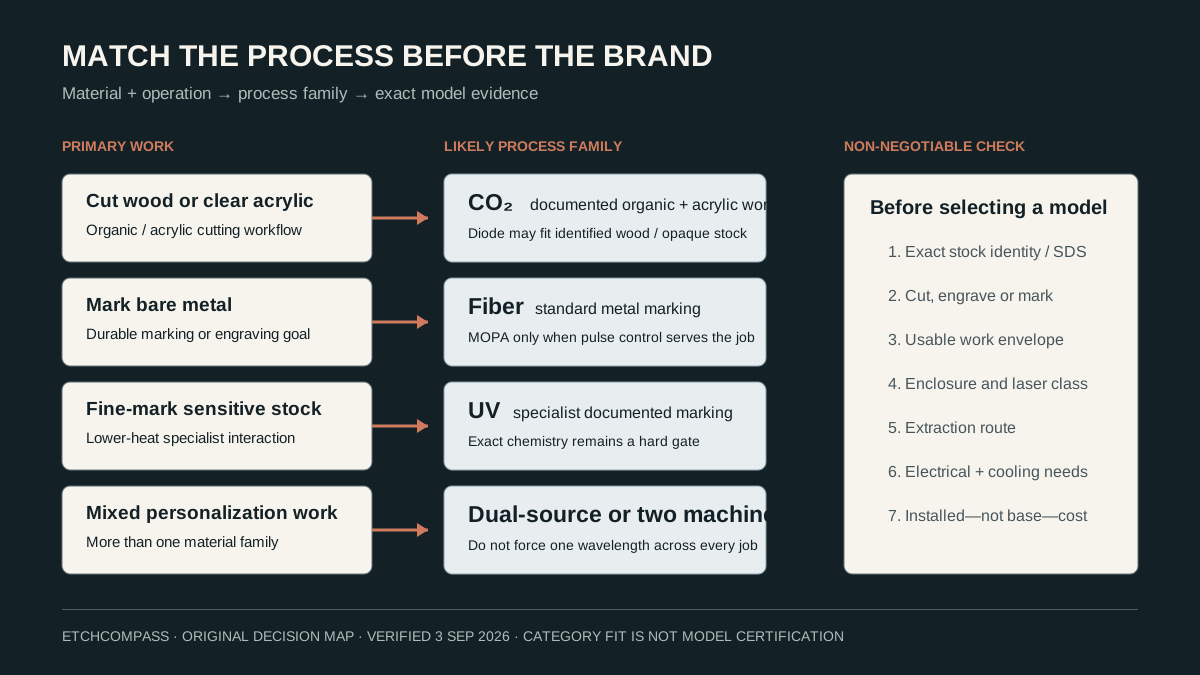
Diode versus CO₂
CO₂ remains the stronger research path for clear PMMA acrylic and for many thicker cutting workflows. A diode may be easier to place or less expensive at the base-machine level, while the full installation still needs enclosure, extraction, fire controls and any required rotary or conveyor.
Compare the production job, not only source watts. A smaller enclosed diode can be the better operational fit for compact engraved goods; a cabinet CO₂ can be the better fit for clear acrylic and larger sheet work.
When to choose another process
For direct marking on bare metals, research conventional fiber or MOPA fiber. For fine marks on selected heat-sensitive materials, investigate UV. For clear acrylic cutting, start with a documented CO₂ workflow.
Choose neither when the stock is unidentified, the required extraction path is unavailable, or the workspace cannot support the exact system controls.
Do not use a flame or burn test to identify plastics. Obtain the supplier SDS/TDS and the exact machine documentation.
Decision criteria
Primary and authoritative sources
A source link supports the stated fact; it is not an endorsement.
- xTool: laser material safety guidance
- Trotec: materials unsuitable for laser processing
- Trotec: acrylic laser processing
- OSHA: laser hazards and controls
- WeCreat Vision Pro: Official WeCreat Vision Pro product page
- WeCreat Vision Pro: Official Vision Pro 45W manual
- WeCreat Vision Pro: Official LightBurn connection requirements
- WeCreat Vision Pro: Official Vision Pro passthrough guide
- WeCreat Vision 20W: Official Vision product page
- WeCreat Vista: WeCreat warranty policy
- WeCreat Vista: Official WeCreat Vista product page
- WeCreat Vista: Official WeCreat Vista support hub