Best for
- Drinkware personalization shops
- Wedding and hospitality suppliers
- Buyers comparing flat-bed and rotary glass workflows
Watch for
- Thermal stress can break glass
- Taper and handles change rotary fit
- A sample is not a production yield guarantee
Machines in this decision
Merchant links are standard outbound links. No active affiliate relationship is recorded, and relationships never affect rankings or tool results. Affiliate status is not a ranking input.
xTool P2S
Evidence recordCO2 · 55 W · 600 × 305 mm
- Fit
- premium enclosed CO₂ workflow
- Watch
- regional SKU/class and warranty must match
- Price context
- $2,999 — US standalone price observed 3 Sep 2026; Versatile was $4,169 and All-in-One $5,069
OMTech Polar Lite
Evidence recordCO2 · 55 W · 510 × 300 mm
- Fit
- enclosed desktop CO₂ buyers
- Watch
- US price and support context
- Price context
- $1,999.99 — US promotional price observed 3 Sep 2026
xTool P3
Evidence recordCO2 · 80 W · 915 × 458 mm
- Fit
- larger-format enclosed CO₂ workflow
- Watch
- 105 kg machine demands route and bench planning
- Price context
- $6,999 — US standalone price observed 3 Sep 2026; Versatile was $8,209 and All-in-one $10,459
WeCreat Lumos Ultra
Evidence recordDual UV/MOPA · 6 W UV; optional 60 W or 100 W MOPA · 210 × 210 mm standard
- Fit
- specialized UV marking
- Watch
- preorder timing conflicted
- Price context
- $3,799 — US UV Basic preorder price observed 3 Sep 2026; configurations extend much higher
ComMarker Omni X UV
Evidence recordUV · 6 W or 12 W configurations · 70 × 70 mm and 150 × 150 mm fields listed in the 6 W Basic bundle; configuration dependent
- Fit
- specialist UV cost research
- Watch
- not a universal cutter
- Price context
- $3,599 — US 6 W Basic promotional price observed 7 Sep 2026; power, lens, slider, rotary and extractor change cost
Evidence desk
Side-by-side documented facts
Each record shows its evidence date. Prices, bundles, availability and regional terms can change; recheck the exact configuration before purchase.
| Criterion | xTool P2S | OMTech Polar Lite | xTool P3 | WeCreat Lumos Ultra | ComMarker Omni X UV |
|---|---|---|---|---|---|
| Laser process | CO2 · 55 W | CO2 · 55 W | CO2 · 80 W | Dual UV/MOPA · 6 W UV; optional 60 W or 100 W MOPA | UV · 6 W or 12 W configurations |
| Published work area | 600 × 305 mm | 510 × 300 mm | 915 × 458 mm | 210 × 210 mm standard | 70 × 70 mm and 150 × 150 mm fields listed in the 6 W Basic bundle; configuration dependent |
| Enclosure / class context | Sold in documented Class 1 and Class 4 versions; verify the exact SKU before purchase | Fully enclosed | Class 1 in the documented standalone configuration; adding the intelligent conveyor changes the system to Class 4 | System class not established in reviewed source | Protective configuration varies by bundle; exact system classification was not established in reviewed text |
| Ventilation context | Built-in 145 CFM exhaust fan and exhaust hose; official guidance routes outdoors and filtration is optional | Built-in exhaust fans and exhaust pipe; verify route and local requirements | IF2 2.0 inline fan included; AP2/AP2 Max filtration is separate unless included in the selected bundle | Extractor optional for most listed configurations | 100 W extractor appears in selected bundles; suitability depends on the exact material and route |
| Machine dimensions | 1,000 × 639 × 268 mm | Not established in the reviewed evidence | 1,250 × 780 × 496 mm in the product/manual table; the FAQ gives 808 mm depth, so plan the route conservatively | 450 × 270 × 442.8 mm | Not established in the reviewed evidence |
| Published weight | 45 kg (99.21 lb) | Not established in the reviewed evidence | 105 kg | 20 kg | Not established in the reviewed evidence |
| Rotary compatibility | Optional rotary; official FAQ lists geometry limits that change when the riser base is used | Not established in the reviewed evidence | Optional RA3/RA2; published ranges depend on roller, chuck, sphere and ring configuration | Rotary supported up to a stated 100 mm diameter; rotary plus slider up to 380 mm length | R5 rotary appears in selected current bundles |
| Electrical / cooling | Maximum machine input listed as 700 W; verify the selected regional voltage and complete accessory load · Built-in liquid-cooling system requires purified water and model-specific, temperature-dependent antifreeze preparation | Not established in the reviewed evidence | 100–240 V AC, 50/60 Hz; official sources conflict between 1,400 W maximum and 1,700 W input · Built-in inverter water chiller with a 1,200 ml tank; use the exact manual's water and antifreeze instructions | Not established in the reviewed evidence | Not established in the reviewed evidence |
| Software | xTool Studio/XCS by USB, Wi-Fi or IP; LightBurn works by cable but does not support the cameras or autofocus | Not established in the reviewed evidence | xTool Studio on Windows/macOS via USB or Wi-Fi; reviewed P3 evidence did not establish LightBurn support | MakeIt and LightBurn on Windows/macOS; USB and Wi-Fi | Verify the exact current software and operating-system support |
| Availability | US standalone and bundles listed for sale on 3 Sep 2026; recheck the exact SKU, classification and cart | Official US product and comparison pages rechecked 7 Sep 2026; verify the exact cart and bundle | US page listed standalone and bundled variants as available with 3–5 business-day shipping on 3 Sep 2026 | Preorder; current product page estimated mid-October shipping when checked 3 Sep 2026 | 6 W and 12 W configurations listed on the official US page on 8 Sep 2026 |
| Published price | $2,999. US standalone price observed 3 Sep 2026; Versatile was $4,169 and All-in-One $5,069 | $1,999.99. US promotional price observed 3 Sep 2026 | $6,999. US standalone price observed 3 Sep 2026; Versatile was $8,209 and All-in-one $10,459 | $3,799. US UV Basic preorder price observed 3 Sep 2026; configurations extend much higher | $3,599. US 6 W Basic promotional price observed 7 Sep 2026; power, lens, slider, rotary and extractor change cost |
| Warranty context | US P2-series terms: 12 months main components, six months laser tube and three months mirrors/focusing lens; regional terms differ | 24 months; official page states two virtual technical-support sessions | Current US product page states 12 months; current UK page states 24 months, so match the region and SKU | 12 months | Verify current regional warranty and selected configuration before purchase |
| Evidence verified | Sep 7, 2026 | Sep 7, 2026 | Sep 7, 2026 | Sep 8, 2026 | Sep 8, 2026 |
Best starting path for ordinary glassware
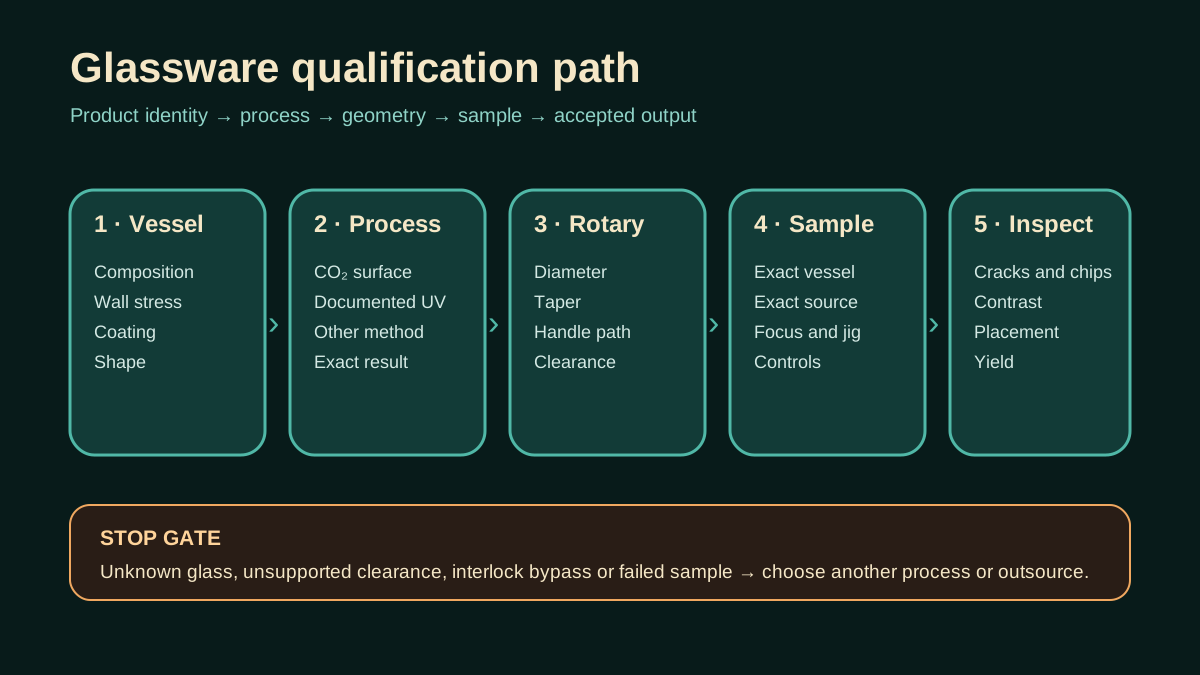
Epilog and Trotec document CO2 surface engraving that creates a frosted appearance on glass. An enclosed CO2 platform with the required object height and supported rotary is the first research path for mixed wine-glass, bottle and flat-glass catalogs.
The exact vessel still needs a controlled sample. Trotec notes that mouth-blown and crystal products can contain stresses intensified by heat, so product quality and breakage must remain explicit acceptance fields.
When a specialist UV path enters
A current documented UV system can enter when fine surface marking, small fields or a particular glass product requires it. A UV marketing image does not establish lower breakage, identical contrast or suitability for every glass composition.
Compare the exact lens, usable field, object height, enclosure, extraction and supported rotary configuration. Require samples on the production vessel, not generic glass coupons.
Qualify rotary geometry before the machine
Measure diameter at the engraving band, taper, length, weight, handle projection, lip and base geometry. Trotec documents rotary alignment for conical and handled glasses and warns that the handle must not rotate into the engraving field.
Use only the machine-supported rotary, cable, riser and installation method. Do not bypass covers or interlocks to gain clearance.
Model finished-glass capacity
Time artwork, proofing, washing, inspection, loading, focus, engraving, unloading, cleaning, final inspection, packaging and breakage. Published head speed is not finished glasses per hour.
Create acceptance limits for chips, cracks, contrast, placement and edge distance. Keep replacement glass and rework in the scenario rather than assuming perfect yield.
Who should choose neither
Choose neither when the glass identity is unresolved, stress or coating is unknown, the vessel cannot be secured within documented geometry, or controls depend on an unsupported open-lid arrangement.
Mechanical engraving, sandblasting or outsourcing may be stronger for fragile premium crystal, unusual shapes or low-volume work.
Glassware sources were rechecked 9 Sep 2026. This guide compares documented processes; EtchCompass did not perform hands-on glass tests.
Decision criteria
Primary and authoritative sources
A source link supports the stated fact; it is not an endorsement.
- Epilog: laser etching and engraving glass
- Trotec: glass laser engraving
- Trotec: rotary engraving attachment workflow
- OSHA: laser hazards and controls
- xTool P2S: Official xTool P2S US product page
- xTool P2S: Official xTool P2S user guide
- xTool P2S: Official P2S classification and material-safety guidance
- xTool P2S: Official P2-series warranty periods
- OMTech Polar Lite: Official OMTech Polar Lite page
- xTool P3: xTool P3 official US product page
- xTool P3: xTool P3 official manual and specifications
- xTool P3: xTool P3 official FAQ
- WeCreat Lumos Ultra: Official Lumos Ultra product page
- ComMarker Omni X UV: Official ComMarker Omni X UV product page