Best for
- MOPA buyers with a defined metal job
- Shops comparing B6 MOPA tiers
- Teams pricing depth and cycle requirements
Watch for
- Power does not guarantee color
- Lens changes field and energy density
- Bundles can obscure the source-tier premium
Machines in this decision
Merchant links are standard outbound links. No active affiliate relationship is recorded, and relationships never affect rankings or tool results. Affiliate status is not a ranking input.
ComMarker B6 MOPA
Evidence recordMOPA fiber · 20 W, 30 W or 60 W configurations · Lens/configuration dependent
- Fit
- dedicated MOPA station
- Watch
- open workflow needs controlled-area assessment
- Price context
- From $2,599 — US 20 W Basic price observed 7 Sep 2026; 30 W and 60 W Basic configurations were $3,099 and $3,999, and control bundles cost more
Evidence desk
Side-by-side documented facts
Each record shows its evidence date. Prices, bundles, availability and regional terms can change; recheck the exact configuration before purchase.
| Criterion | ComMarker B6 MOPA |
|---|---|
| Laser process | MOPA fiber · 20 W, 30 W or 60 W configurations |
| Published work area | Lens/configuration dependent |
| Enclosure / class context | Open marking format in reviewed product evidence |
| Ventilation context | No universal extraction configuration established |
| Machine dimensions | Not established in the reviewed evidence |
| Published weight | Not established in the reviewed evidence |
| Rotary compatibility | Not established in the reviewed evidence |
| Electrical / cooling | Not established in the reviewed evidence |
| Software | Not established in the reviewed evidence |
| Availability | 20 W, 30 W and 60 W configurations listed for sale on the official US page on 7 Sep 2026 |
| Published price | From $2,599. US 20 W Basic price observed 7 Sep 2026; 30 W and 60 W Basic configurations were $3,099 and $3,999, and control bundles cost more |
| Warranty context | Verify current regional warranty before purchase |
| Evidence verified | Sep 7, 2026 |
What 30 W does better
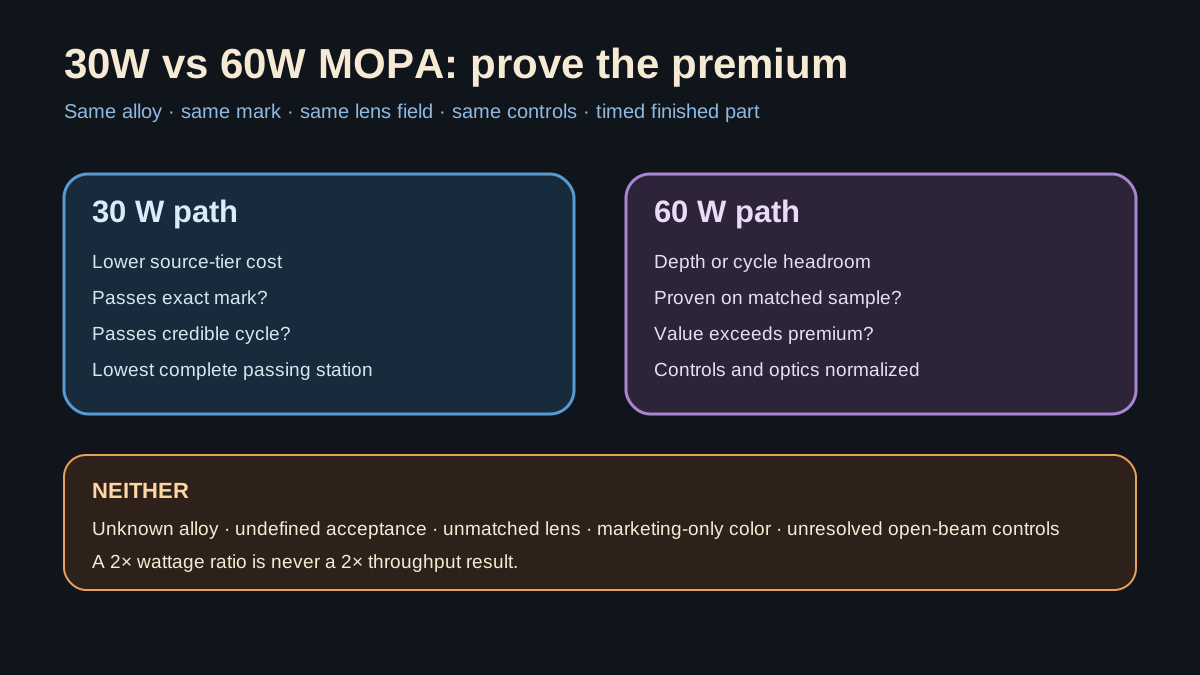
The current ComMarker B6 MOPA page lists a 30 W tier for color marking, engraving and deep-engraving research. It is the lower-cost and lower-power choice when the exact finished-part acceptance and cycle target pass.
Normalize lens, enclosure, extraction, fixture, software and support before attributing a quote difference to power.
What 60 W does better
The same official page positions its 60 W tier for color marking, engraving, deep engraving and selected metal-cutting research. Higher average power can offer depth or cycle headroom, but only an exact timed sample establishes the useful gain.
Treat cutting as exact-material and exact-thickness evidence, not a general sheet-metal capability.
Limitations of 30 W
A 30 W configuration may require too many passes or too much cycle time for a qualified depth target. That cannot be determined from source watts alone.
A smaller field can increase energy density while reducing part coverage. Qualify the quoted optical package.
Limitations of 60 W
The 60 W premium is wasted when 30 W already passes. More power cannot identify an alloy, fix a weak fixture, create process control or make a marketing color repeatable.
Open-format systems still require a controlled-area assessment, guarding decisions and contaminant controls. Do not trade away safety for source power.
Who should choose each—or neither
Choose 30 W when matched finished-part evidence passes at credible capacity. Choose 60 W when the same test proves valuable depth, cycle or process headroom after its complete cost is included.
Choose neither when the alloy, mark specification, lens, sample method or controls are unresolved. A conventional fiber or specialist UV process may be the better fit.
The official B6 MOPA configurations were rechecked 9 Sep 2026. Vendor category claims are not EtchCompass throughput tests.
Decision criteria
Primary and authoritative sources
A source link supports the stated fact; it is not an endorsement.